LASEK in Seoul Korea |
Cost & Patient Reviews | Price KRW 4.2mil
LASEK in Seoul, Korea — Surface Laser for Thinner Corneas
LASEK/PRK reshapes the corneal surface with no flap and no incision, preserving the most corneal stroma. Both eyes ₩2.2M–₩2.8M at BGSS, exam included; expect 3–5 days of recovery.
- Both eyes ₩2.2M–₩2.8M (≈ $1,550–$1,980), exam included
- No flap — suits thinner corneas and contact sports
- Performed by surgeons who pioneered LASEK in Korea
What is LASEK and who should choose it over LASIK?
LASEK is a surface laser procedure: the thin outer epithelium is moved aside, an excimer laser reshapes the corneal surface, and the epithelium regrows under a bandage contact lens. With no flap, it leaves more stroma intact, so it suits thinner corneas or contact-sport athletes. At BGSS it costs ₩2.2M–₩2.8M for both eyes, with 3–5 days of recovery.
- Price (both eyes)
- ₩2.2M – ₩2.8M
- Flap
- None
- Recovery
- 3–5 days
- Best for
- Thinner corneas, contact sports
How LASEK works — step by step at the corneal surface
The cornea has an outer skin, the epithelium , over the thicker stroma . In LASEK the epithelium is gently loosened and moved aside (in PRK it is removed); an excimer laser then sculpts the front of the stroma to correct myopia, hyperopia or astigmatism .
There is no flap and no lenticule, so the full depth of the remaining stroma stays structurally intact. The trade-off is healing: the epithelium needs a few days to regrow, during which a bandage contact lens protects the eye and vision is blurrier than after LASIK or SMILE Pro.
- Corrects: myopia, hyperopia and astigmatism
- No flap: no flap-related complications in later life
- Tissue sparing: leaves more residual stroma than LASIK
- Healing: surface regrows over about 3–5 days
Key point: LASEK is not "old" technology — it remains the safer laser choice for some corneas. The choice depends on your measurements, not on what is newest.
When LASEK is the better choice
Situations where surgeons commonly prefer surface treatment, based on AAO guidance.
LASEK often preferred
- Corneas too thin for a LASIK flap
- Contact sports, martial arts or military/police work
- Previous corneal surgery where a flap is undesirable
- Some patients with surface irregularities that need smoothing
Consider something else
- Need to return to work within 1–2 days → LASIK or SMILE Pro
- Very high myopia → EVO ICL
- Keratoconus or progressive corneal thinning → laser not advised
- Active eye disease, pregnancy or breastfeeding → postpone
Your treatment plan and price within 24 hours
- 1 Send a photo of your glasses or prescription
- 2 Get a likely procedure and estimated cost
- 3 Reserve an exam slot for your trip
No obligation · English · 中文 · 日本語 · Tiếng Việt · Монгол · Bahasa Indonesia
LASEK recovery timeline
Recovery is slower than LASIK — plan your trip accordingly.
Days 1–3
Bandage lens in place. Light sensitivity, watering and discomfort are common; prescribed drops and rest help.
Days 3–5
Epithelium closes; bandage lens removed at the clinic. Functional vision for daily tasks returns for most people.
Weeks 1–4
Vision keeps sharpening. Steroid drops are tapered as directed to reduce haze risk.
Months 1–3
Final clarity stabilises. Remote follow-up continues after you return home.
LASEK vs LASIK vs SMILE Pro
Three laser options that work on the cornea in different ways.
| LASEK / PRK | LASIK | SMILE Pro | |
|---|---|---|---|
| Access | Surface (epithelium moved) | Femtosecond flap | 2–4 mm incision |
| Corneal strength | Most stroma preserved | Flap reduces load-bearing stroma | Front layers largely intact |
| Recovery | 3–5 days | Next day | 1–2 days |
| Early comfort | More discomfort first days | Mild | Mild |
| BGSS price, both eyes | ₩2.2M–₩2.8M | ₩1.9M–₩2.4M | ₩2.5M–₩4.0M |
Typical characteristics. Sources: AAO EyeWiki (PRK), FDA.
LASEK risks: what to know
Published reviews list post-operative pain, delayed epithelial healing, corneal haze, infection, glare and under- or over-correction as possible effects of surface ablation. Haze is more likely with higher corrections and is reduced with appropriate drops and UV protection.
BGSS surgeons were among Korea's early adopters of LASEK, and the clinic follows JCI-standard infection-control and medication safety processes. You will receive written instructions in English and remote follow-up after you fly home.
- Wear sunglasses outdoors for several months
- Use steroid drops exactly as prescribed
- Do not rub your eyes while the surface heals
- Report sudden pain or redness immediately
BGSS Eye Clinic 2026 prices
Every package includes the pre-operative exam, the surgery and standard post-op medications.
| Procedure | Price (KRW) | Approx. USD | Recovery |
|---|---|---|---|
| LASIK (both eyes) | ₩1,900,000 – ₩2,400,000 | $1,340 – $1,690 | 1 day |
| LASEK / PRK (both eyes) | ₩2,200,000 – ₩2,800,000 | $1,550 – $1,980 | 3–5 days |
| SMILE / SMILE Pro (both eyes) | ₩2,500,000 – ₩4,000,000 | $1,760 – $2,830 | 1–2 days |
| EVO ICL (both eyes) | ₩5,200,000 – ₩7,000,000 | $3,670 – $4,950 | 1 day |
| Cataract / presbyopia lens (per eye) | ₩1,500,000 – ₩7,250,000 | $1,060 – $5,120 | 1–2 days |
USD values are approximate and vary with exchange rates. Final pricing is confirmed after your pre-operative exam.
- Full pre-operative diagnostic exam (2–3 hours)
- Surgery performed by a board-certified ophthalmologist
- Standard post-op eye drops and check-ups before you fly
- Medical interpreter and English medical records
Which procedure fits your eyes?
Answer 3 quick questions to see the procedure most often suited to people like you, with the 2026 starting price. Then send it to a coordinator for a free personal review.
- FREE No obligation, no deposit to ask
- 24h Reply from our international team
- MD Final plan confirmed by an ophthalmologist after your exam
How old are you?
Written and reviewed by the surgeons who perform it
Every figure on this page is a published BGSS total or a public credential you can check.
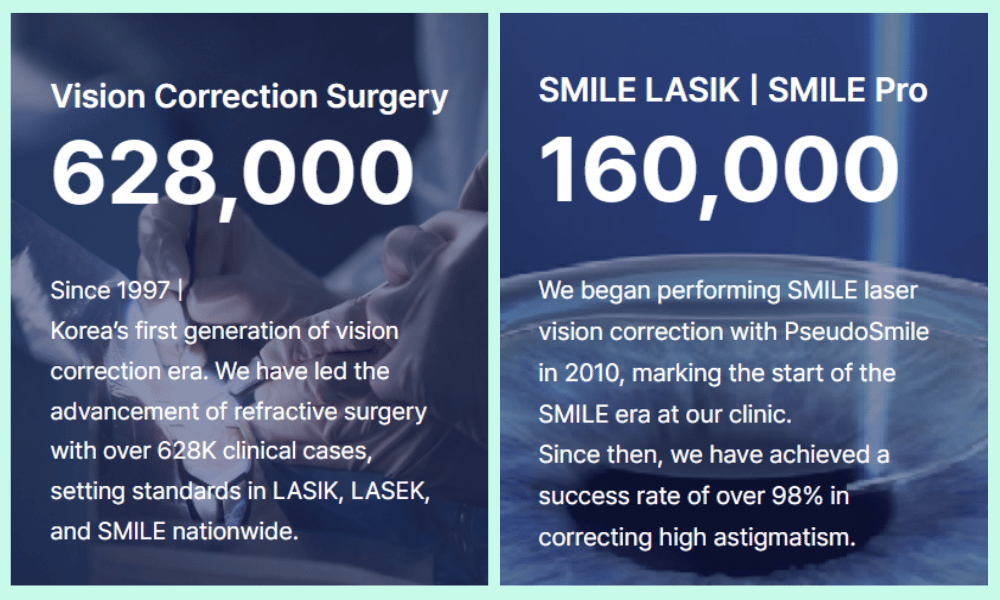
- 160,000+ SMILE / SMILE Pro
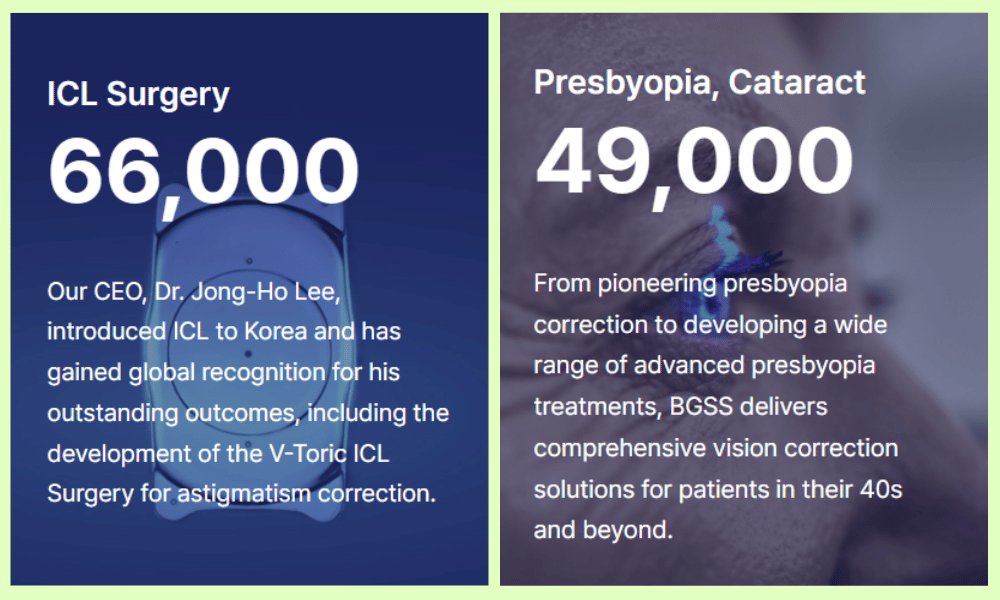
- 66,000+ ICL lens implants
- 49,000+ presbyopia & cataract
- Many with M.D., Ph.D. research backgrounds
- Founder Dr. Jong-Ho Lee: 56,000+ ICL eyes
- Complex-case and toric ICL positioning
- STAAR Surgical EVO ICL APAC Experts Summit (2024)
- Korea SMILE Forum (2025)
- Korea EVO ICL Forum (2025)
- Among Korea's first to introduce LASIK & LASEK
- Ministry of Health & Welfare–designated regenerative medicine institution
- 2026 prices published openly
- Medical content reviewed by an ophthalmologist
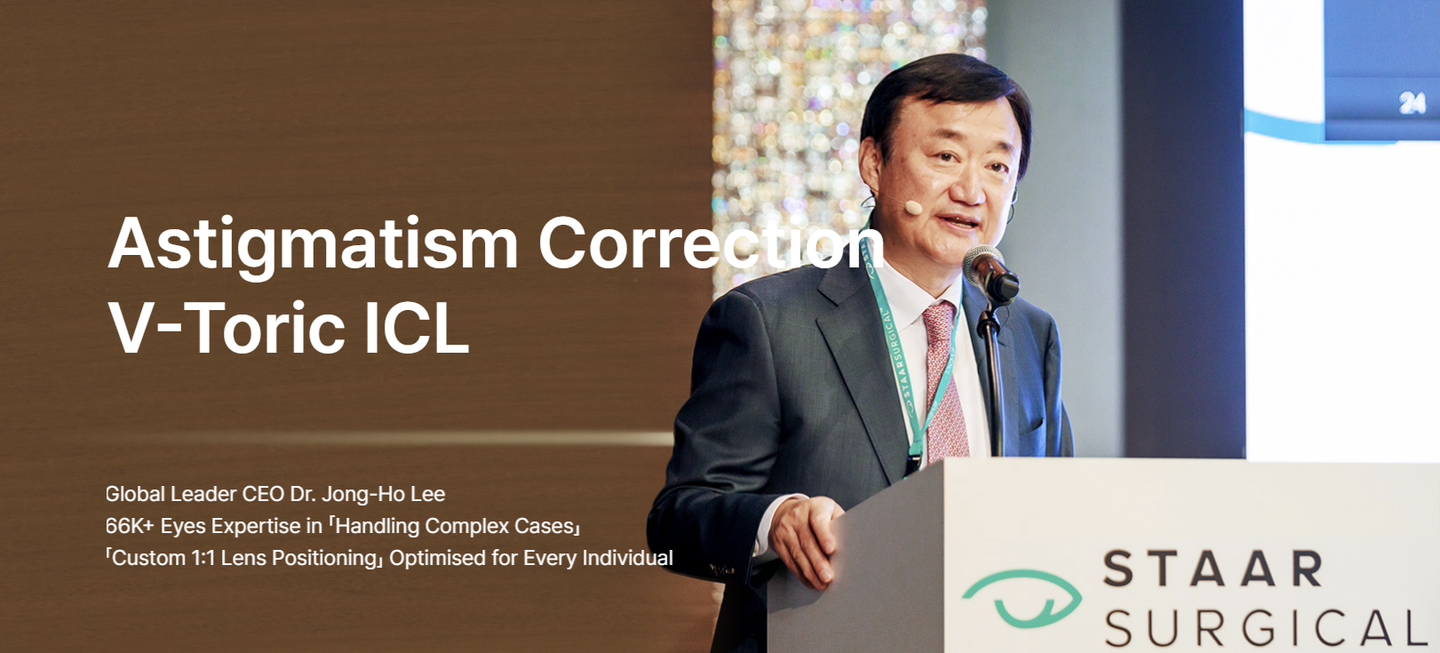
Dr. Jong-Ho Lee, M.D., Ph.D.
Dr. Lee is a pioneer of first-generation LASIK, LASEK and ICL in Korea and is known internationally for complex-case ICL and custom lens positioning for astigmatism. He reviews the medical content on this website.
Editorial policy: clinical statements on this page are checked against the sources below and BGSS outcome data, and are reviewed at least once a year. Prices are the clinic's published 2026 rates.
How surgery in Korea works, step by step
Most international patients plan a stay of about one week. Your coordinator confirms the exact timeline after reviewing your records.
Send your details
WhatsApp, LINE, WeChat or KakaoTalk your prescription and preferred dates. Free, with no obligation.
Get a personal plan
Receive a likely procedure, an estimated cost and a reserved exam slot.
Exam & surgery in Seoul
A 2–3 hour exam with your surgeon. If suitable, surgery can often be the same or next day.
Follow-up & fly home
Post-op checks before departure, then remote follow-up. Your surgeon confirms when it is safe to fly.
Frequently asked questions
How much does LASEK cost in Korea?
At BGSS, LASEK/PRK costs ₩2,200,000–₩2,800,000 (about $1,550–$1,980) for both eyes, including exam, surgery and standard medications. Old figures such as KRW 4.2 million are outdated.
Is LASEK more painful than LASIK?
Surgery itself is done under numbing drops. Afterwards, LASEK usually causes more discomfort for 2–3 days while the surface heals; prescribed drops and the bandage lens help.
How long should I stay in Korea for LASEK?
Plan about a week so the bandage lens can be removed and your surface checked before you fly. Your coordinator will confirm the timeline.
What is the difference between LASEK and PRK?
Both are surface treatments. In LASEK the epithelium is loosened and moved aside; in PRK it is removed. Healing and results are similar; your surgeon chooses the technique.
Is LASEK good for thin corneas?
Often, yes — because no flap is cut, more stroma remains. If the cornea is very thin or irregular, EVO ICL may be safer.
Can I do sport after LASEK?
Light exercise usually resumes after about a week; contact sports and swimming later, as your surgeon advises. With no flap, LASEK is often chosen by athletes.
Ready to see clearly? Start with a free consultation.
Send your prescription today and get a personal treatment plan and price estimate within 24 hours.
- Free consultation
- No obligation
- Reply within 24 hours
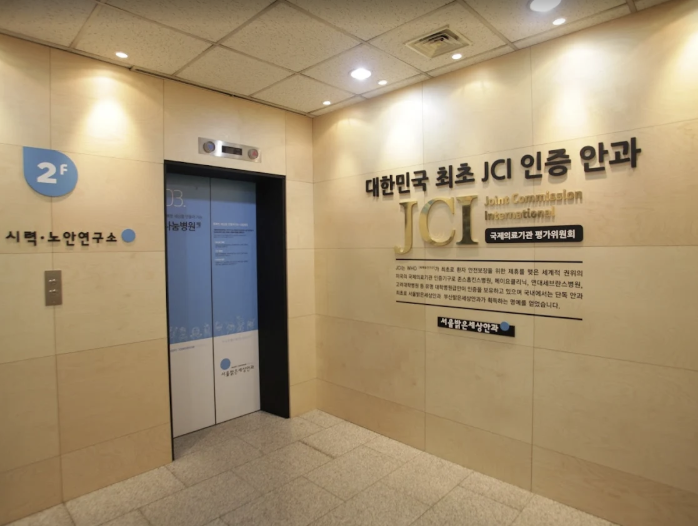
- Korea's first JCI-accredited eye clinic
Medical information on this page is for general education and does not replace a consultation with an ophthalmologist. Results vary by individual, and suitability is determined after a full pre-operative eye examination. Statistics: BGSS Seoul + Busan cumulative totals as of December 2025.
LASEK Surgery in Seoul, Korea: A Safe & Effective Vision Correction
LASEK (Laser-Assisted Subepithelial Keratectomy) surgery is a popular vision correction option in Seoul, Korea, ideal for individuals with thin corneas or those unsuitable for LASIK. This advanced procedure reshapes the cornea to correct nearsightedness, farsightedness, and astigmatism while preserving more corneal tissue.
Why Choose LASEK in Seoul?
- Ideal for Thin Corneas – A great alternative to LASIK for those with lower corneal thickness.
- No Flap Complications – Unlike LASIK, LASEK does not create a corneal flap, reducing the risk of complications.
- Long-Term Stability – Provides lasting vision correction with minimal regression.
- Affordable Pricing – High-quality eye care at a fraction of the cost compared to Western countries.
- Top-Tier Clinics – Seoul has some of the best ophthalmology centers with state-of-the-art technology.
LASEK Surgery Procedure
- Pre-Surgery Consultation – A detailed eye exam determines if LASEK is the right choice.
- Epithelial Removal – The outer layer of the cornea is softened and gently lifted.
- Laser Reshaping – A precise excimer laser reshapes the cornea to correct vision.
- Healing Process – The epithelial layer regenerates naturally over a few days.
- Recovery & Follow-Up – Vision improves gradually over a few weeks with proper post-op care.
LASEK surgery in Seoul, Korea, is an excellent option for those who need a reliable, flap-free vision correction procedure. With highly skilled ophthalmologists, advanced technology, and affordable pricing, Seoul remains a leading choice for those seeking clear vision without LASIK.