Wavefront LASIK in Korea —
Advanced Vision Correction in Seoul
Wavefront LASIK in Seoul — Correcting Higher-Order Aberrations
Wavefront-guided LASIK measures how light actually travels through your eye and uses that map to guide the laser — targeting not just your prescription but subtle distortions linked to night glare. Both eyes ₩1.9M–₩2.4M at BGSS.
- Laser guided by your eye's own aberration map
- Bladeless femtosecond flap
- Both eyes ₩1.9M–₩2.4M (≈ $1,340–$1,690), exam included
What is wavefront LASIK and is it better than standard LASIK?
Wavefront-guided LASIK uses an aberrometer to measure how a beam of light is distorted as it passes through your eye, then programs the excimer laser to correct both your prescription and higher-order aberrations. Studies suggest it can improve contrast and reduce some night-vision symptoms compared with conventional treatment in suitable eyes. At BGSS, LASIK costs ₩1.9M–₩2.4M for both eyes.
- Measures
- Whole-eye wavefront
- Targets
- Lower- and higher-order aberrations
- Price (both eyes)
- ₩1.9M – ₩2.4M
- Recovery
- Next day
What is a wavefront — and what are higher-order aberrations?
Imagine a flat sheet of light entering a perfect eye: it would focus to a single sharp point. Real eyes bend that "wavefront" unevenly. Lower-order aberrations — myopia, hyperopia and regular astigmatism — are what glasses correct.
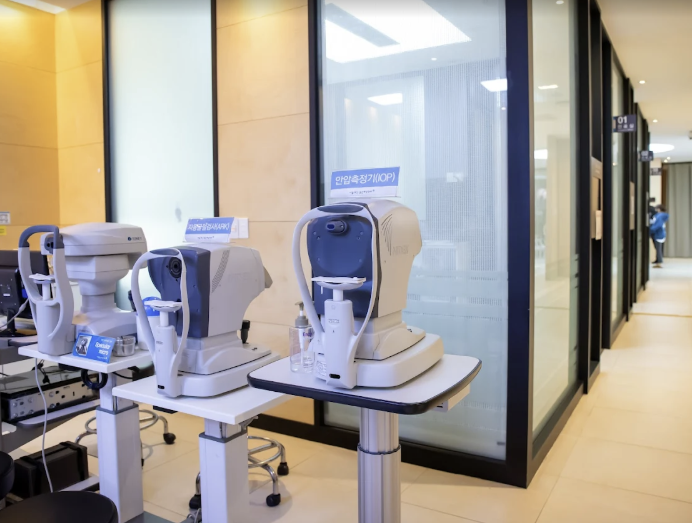
The remainder are higher-order aberrations (HOAs) such as coma, trefoil and spherical aberration. They are small, but they affect contrast and can show up as halos, glare or starbursts in dim light when the pupil is large. A wavefront aberrometer measures these with a Hartmann-Shack sensor that analyses light reflected from the retina.
- Coma: comet-like smear of point lights
- Spherical aberration: halos with large pupils at night
- Trefoil: three-pointed starburst
- Measured: through the whole optical system, not just the cornea
Key point: wavefront treatment aims to avoid adding new aberrations and to reduce existing ones — it does not promise "better than 20/20" vision.
Wavefront-guided vs conventional vs topography-guided
Three ways to plan the laser profile.
| Conventional | Wavefront-guided | Topography-guided | |
|---|---|---|---|
| Based on | Glasses prescription | Whole-eye wavefront map | Corneal surface shape |
| Treats HOAs? | No; may induce some | Yes, from the whole eye | Yes, from the cornea |
| Best suited to | Simple prescriptions | Measurable HOAs, normal cornea | Irregular corneal surface |
| At BGSS | Not the default | Available | Available |
Your surgeon chooses the profile from your measurements. See also custom LASIK and bladeless LASIK.
Your treatment plan and price within 24 hours
- 1 Send a photo of your glasses or prescription
- 2 Get a likely procedure and estimated cost
- 3 Reserve an exam slot for your trip
No obligation · English · 中文 · 日本語 · Tiếng Việt · Монгол · Bahasa Indonesia
Who benefits most from wavefront guidance?
General guidance; benefit varies between individuals.
Likely to benefit
- Measurable higher-order aberrations on aberrometry
- Larger pupils in dim light
- Night driving or night-vision concerns
- Normal corneal thickness for LASIK
Other approaches may suit better
- Unreliable wavefront capture (e.g. small pupils, dry eye)
- Irregular corneal surface → topography-guided
- Thin cornea → LASEK or ICL
- Very high myopia → EVO ICL
Limits and risks
Wavefront guidance is a planning tool, not a separate operation: it carries the same risks as any LASIK, including dry eye, glare, halos, under- or over-correction and rare flap complications (FDA).
Measurements must be reliable. A disturbed tear film can distort the wavefront reading, so BGSS checks and treats dry eye before capture and repeats scans to confirm consistency.
- Repeat scans for consistency
- Tear film optimised before measurement
- Treatment map aligned to the eye before the laser
- Final plan approved by your surgeon
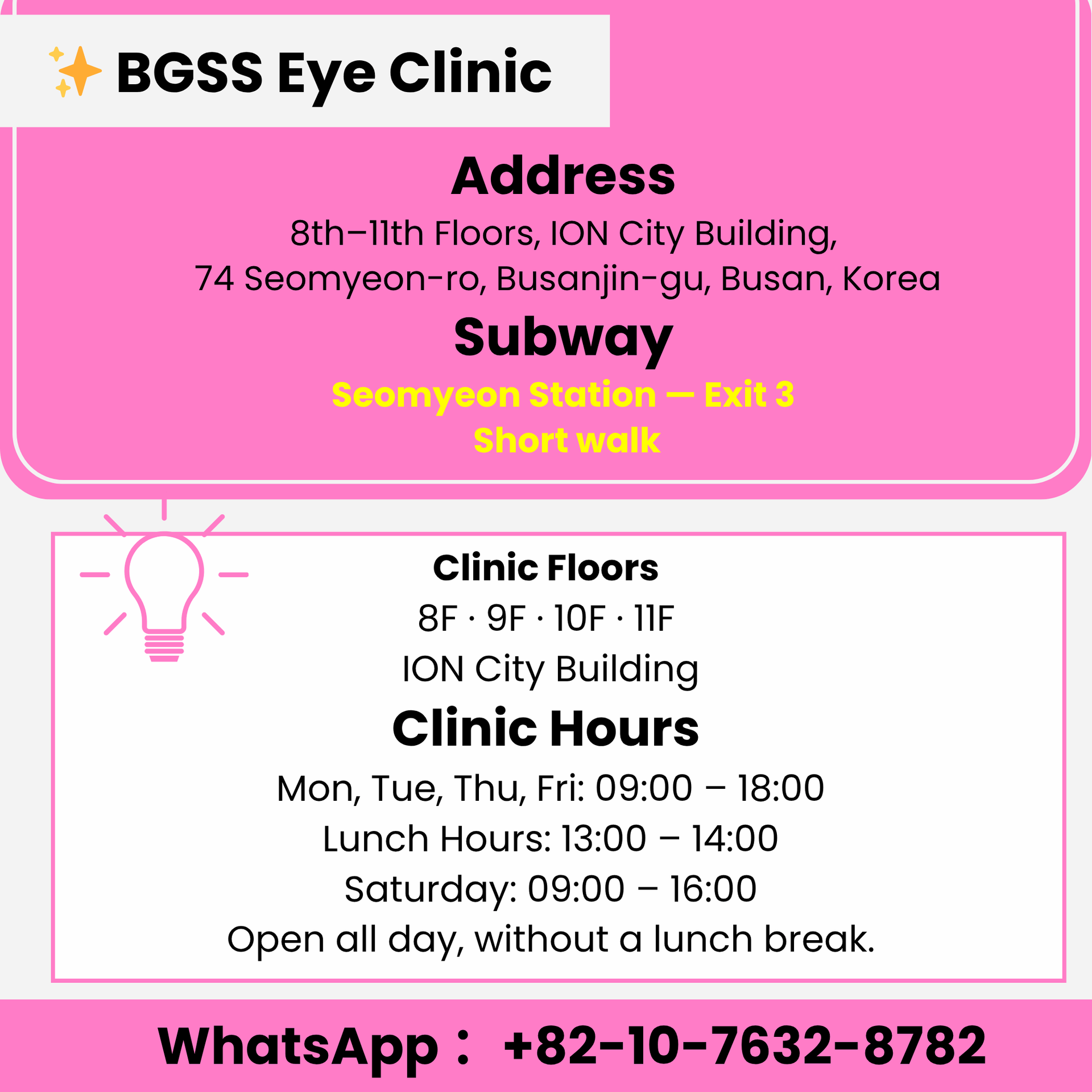
BGSS Eye Clinic 2026 prices
Every package includes the pre-operative exam, the surgery and standard post-op medications.
| Procedure | Price (KRW) | Approx. USD | Recovery |
|---|---|---|---|
| LASIK (both eyes) | ₩1,900,000 – ₩2,400,000 | $1,340 – $1,690 | 1 day |
| LASEK / PRK (both eyes) | ₩2,200,000 – ₩2,800,000 | $1,550 – $1,980 | 3–5 days |
| SMILE / SMILE Pro (both eyes) | ₩2,500,000 – ₩4,000,000 | $1,760 – $2,830 | 1–2 days |
| EVO ICL (both eyes) | ₩5,200,000 – ₩7,000,000 | $3,670 – $4,950 | 1 day |
| Cataract / presbyopia lens (per eye) | ₩1,500,000 – ₩7,250,000 | $1,060 – $5,120 | 1–2 days |
USD values are approximate and vary with exchange rates. Final pricing is confirmed after your pre-operative exam.
- Full pre-operative diagnostic exam (2–3 hours)
- Surgery performed by a board-certified ophthalmologist
- Standard post-op eye drops and check-ups before you fly
- Medical interpreter and English medical records
Which procedure fits your eyes?
Answer 3 quick questions to see the procedure most often suited to people like you, with the 2026 starting price. Then send it to a coordinator for a free personal review.
- FREE No obligation, no deposit to ask
- 24h Reply from our international team
- MD Final plan confirmed by an ophthalmologist after your exam
How old are you?
Written and reviewed by the surgeons who perform it
Every figure on this page is a published BGSS total or a public credential you can check.
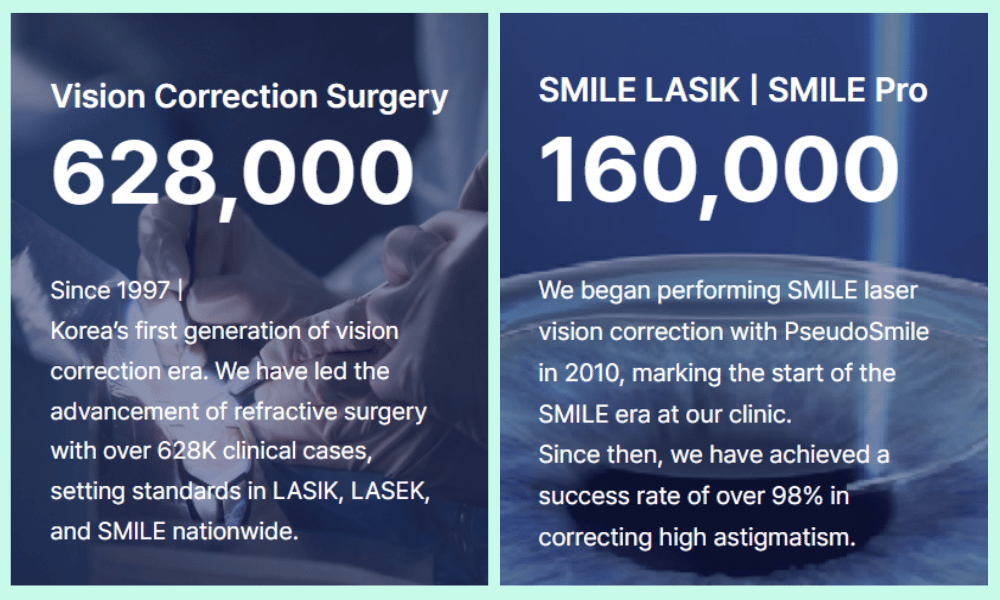
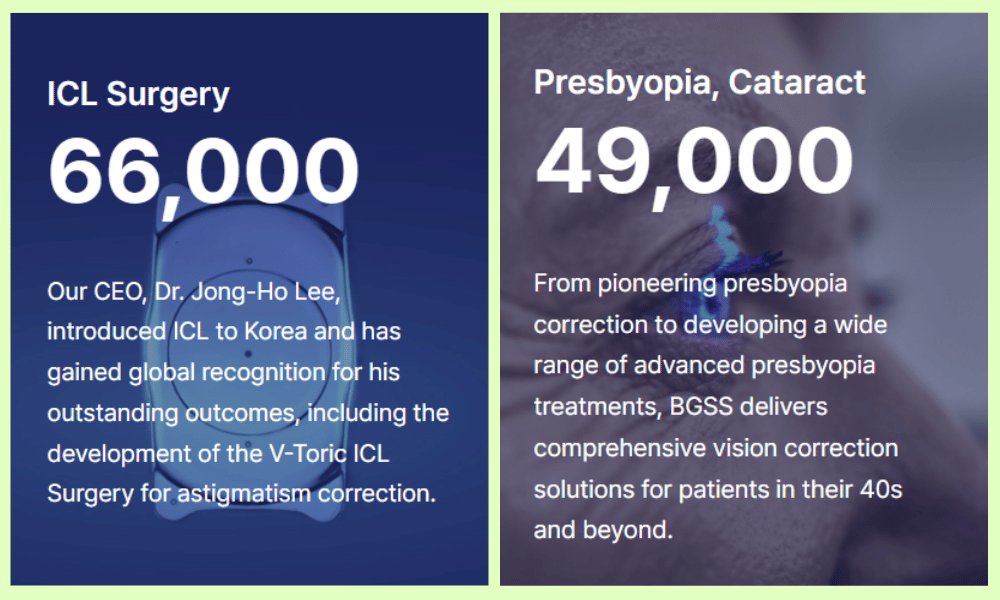
- 160,000+ SMILE / SMILE Pro
- 66,000+ ICL lens implants
- 49,000+ presbyopia & cataract
- Many with M.D., Ph.D. research backgrounds
- Founder Dr. Jong-Ho Lee: 56,000+ ICL eyes
- Complex-case and toric ICL positioning
- STAAR Surgical EVO ICL APAC Experts Summit (2024)
- Korea SMILE Forum (2025)
- Korea EVO ICL Forum (2025)
- Among Korea's first to introduce LASIK & LASEK
- Ministry of Health & Welfare–designated regenerative medicine institution
- 2026 prices published openly
- Medical content reviewed by an ophthalmologist
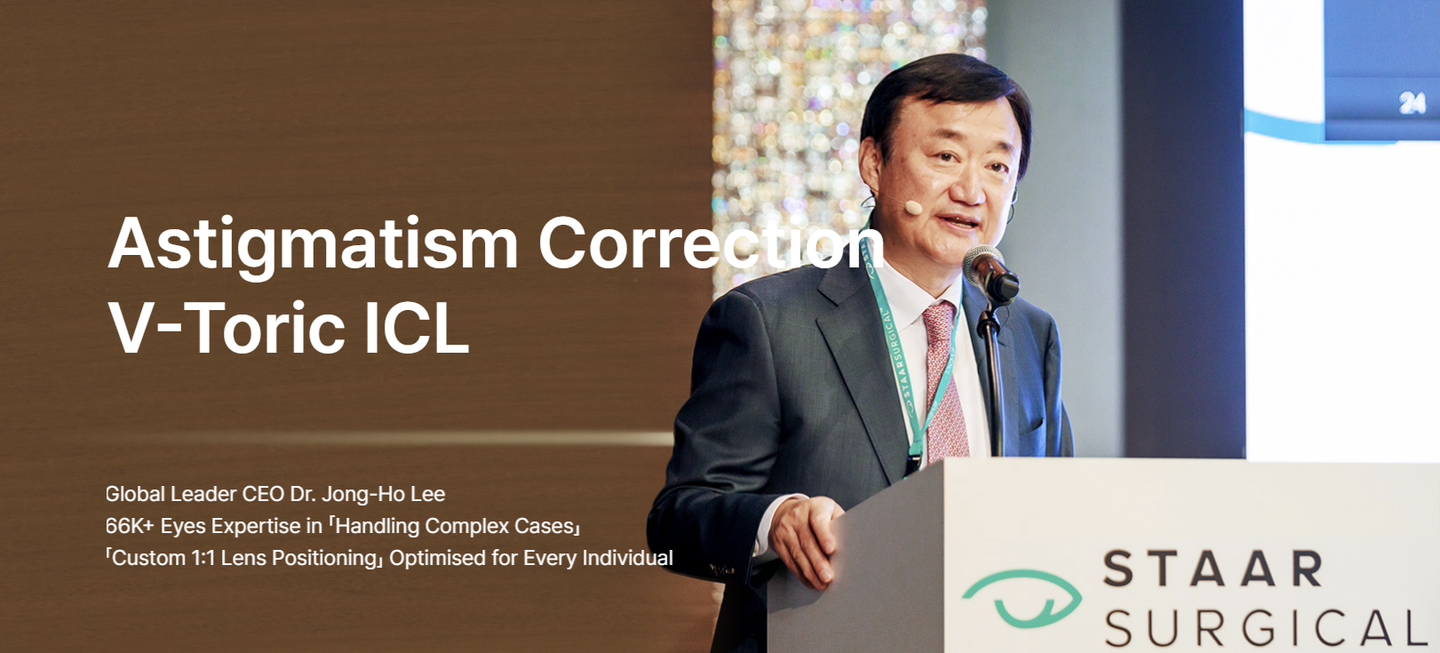
Dr. Jong-Ho Lee, M.D., Ph.D.
Dr. Lee is a pioneer of first-generation LASIK, LASEK and ICL in Korea and is known internationally for complex-case ICL and custom lens positioning for astigmatism. He reviews the medical content on this website.
Editorial policy: clinical statements on this page are checked against the sources below and BGSS outcome data, and are reviewed at least once a year. Prices are the clinic's published 2026 rates.
How surgery in Korea works, step by step
Most international patients plan a stay of about one week. Your coordinator confirms the exact timeline after reviewing your records.
Send your details
WhatsApp, LINE, WeChat or KakaoTalk your prescription and preferred dates. Free, with no obligation.
Get a personal plan
Receive a likely procedure, an estimated cost and a reserved exam slot.
Exam & surgery in Seoul
A 2–3 hour exam with your surgeon. If suitable, surgery can often be the same or next day.
Follow-up & fly home
Post-op checks before departure, then remote follow-up. Your surgeon confirms when it is safe to fly.
Frequently asked questions
Is wavefront LASIK the same as custom LASIK?
Wavefront-guided LASIK is one type of custom LASIK. "Custom" can also mean topography-guided or wavefront-optimised profiles. See custom LASIK in Korea.
Does wavefront LASIK cost more at BGSS?
Wavefront and topography customisation are part of BGSS LASIK, priced at ₩1,900,000–₩2,400,000 (about $1,340–$1,690) for both eyes including the exam.
Will wavefront LASIK eliminate night halos?
It aims to reduce aberrations linked to halos, but cannot guarantee their absence. Some halos are common early after any LASIK and usually improve.
Is the flap made with a blade?
No. BGSS creates LASIK flaps with a femtosecond laser. See bladeless LASIK.
How long is recovery?
Most people have functional vision the next day, as with other LASIK. Plan about a week in Korea for exam, surgery and checks.
Ready to see clearly? Start with a free consultation.
Send your prescription today and get a personal treatment plan and price estimate within 24 hours.
- Free consultation
- No obligation
- Reply within 24 hours
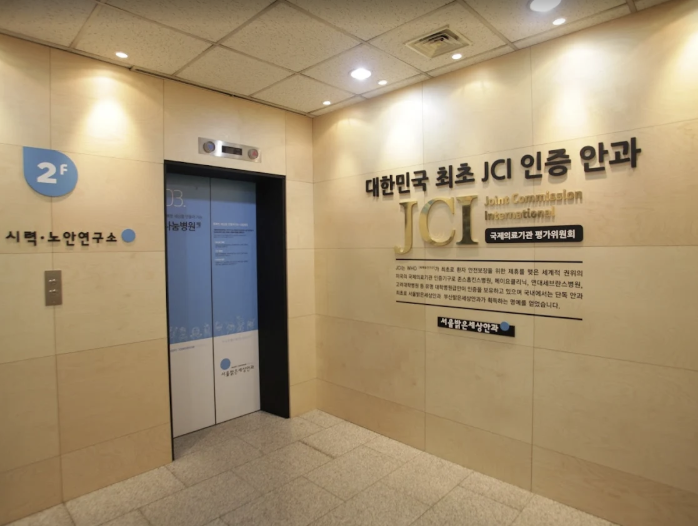
- Korea's first JCI-accredited eye clinic
Medical information on this page is for general education and does not replace a consultation with an ophthalmologist. Results vary by individual, and suitability is determined after a full pre-operative eye examination. Statistics: BGSS Seoul + Busan cumulative totals as of December 2025.
What is Wavefront LASIK (Custom LASIK)?
Wavefront LASIK — often called customized LASIK — is a high-precision laser vision correction procedure that uses detailed wavefront mapping of your eye to correct higher-order aberrations in addition to standard refractive errors (myopia, hyperopia, and astigmatism). This personalized approach can improve visual clarity and reduce post-surgical side effects like glare and halos compared with traditional LASIK.
Why Choose BGSS Eye Clinic for Wavefront LASIK?
Seoul BGSS Eye Clinic is one of Korea’s most experienced vision correction centers, founded by Dr. Jong-Ho Lee, a leading specialist in refractive surgery, with a long history in LASIK and advanced vision correction procedures dating back to its establishment in 1997.
Clinic Strengths
- Pioneers of LASIK in Korea — Led by founder Dr. Jong-Ho Lee, BGSS Eye Clinic is a first-generation vision correction center that introduced LASIK and LASEK procedures to Korea, establishing a strong foundation in advanced refractive surgery.
- Over 600,000+ precision procedures performed, demonstrating depth of clinical experience.
- Multilingual support — English, Japanese, Chinese, and Mongolian coordination available for international patients.
- Comprehensive pre-surgical evaluation using advanced diagnostic tools to tailor the optimal laser correction strategy for your eyes.
- Modern laser platforms (SMILE Pro, ZEISS VISUMAX series) providing state-of-the-art refractive solutions.
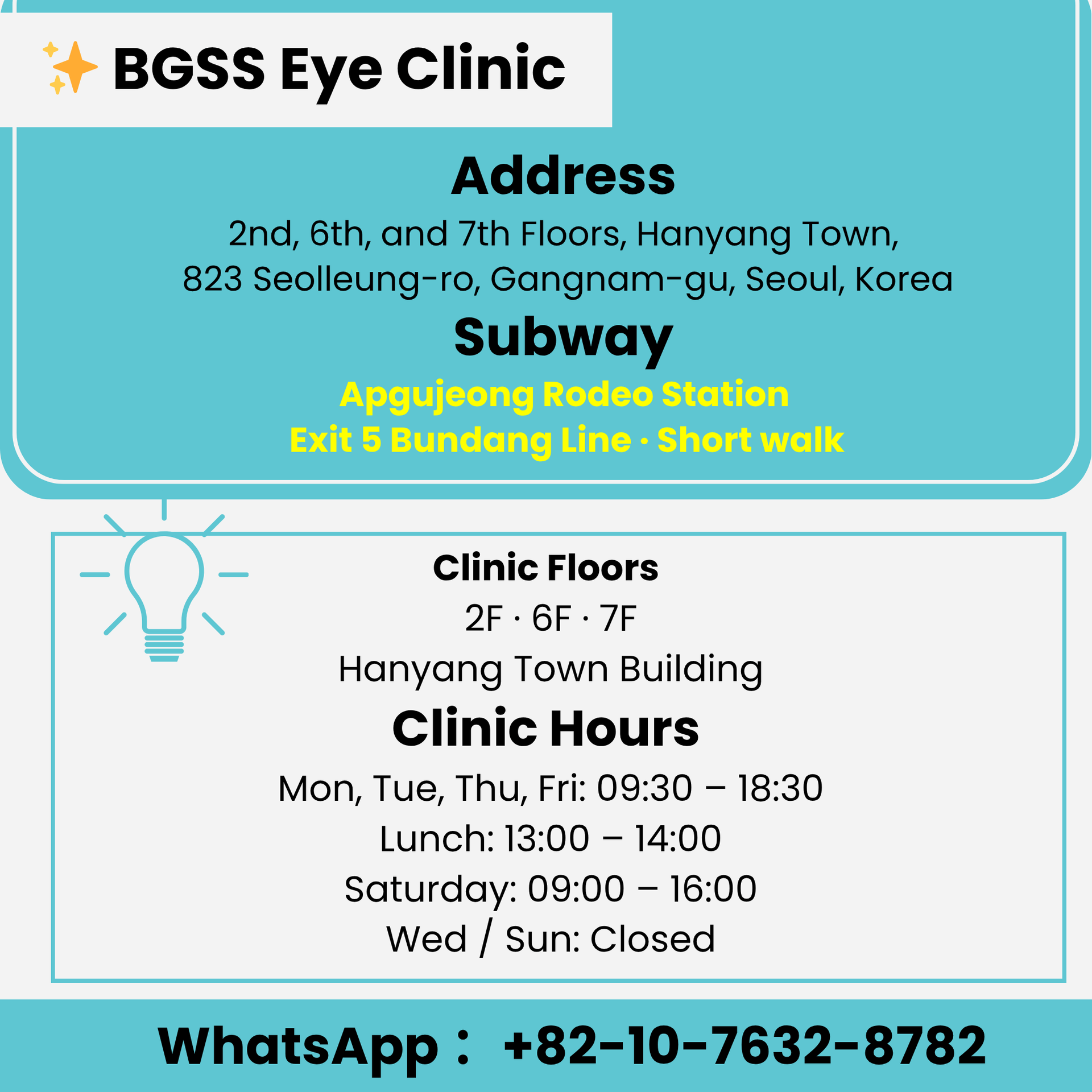
Clinic Location & Contact (Apgujeong, Gangnam, Seoul)
- Address: 823 Seolleung-ro, Gangnam-gu, Seoul, Korea (Hanyang Town Building, multiple floors)
- Closest Station: Apgujeong Rodeo Station (Bundang Line)
- Phone: +82-02-3443-0880
- Hours: Mon, Tue, Thu, Fri: 09:30–18:30; Sat: 09:00–16:00; Closed Wed & Sun
How the Wavefront LASIK Process Works
- Detailed Pre-operative Assessment
Comprehensive wavefront aberrometry, corneal topography, and ocular health evaluation determine your LASIK candidacy. - Customized Treatment Mapping
Your unique wavefront map guides the excimer laser to correct subtle optical imperfections. - Laser Correction Procedure
Performed under topical anesthesia; typically completed within minutes per eye. - Post-Surgical Recovery & Follow-Up
Most patients notice improved vision within 24–48 hours, with scheduled follow-ups ensuring optimal outcome.
Note: Not all clinics use the term “Wavefront LASIK” equally — at many advanced centers like BGSS, customized laser protocols and precision diagnostics are integrated into SMILE, LASIK, and Topography-guided treatments.
Pricing & Promotions
Prices vary by procedure type, technology used, and individual eye conditions. While Korea’s refractive surgery costs generally range depending on method (e.g., SMILE, LASIK, PRK, etc.), advanced customized options typically fall within a premium tier.
BGSS hosts seasonal promotions and package discounts — including student specials on refractive surgeries.