Custom LASIK in Korea –
Seoul BGSS Eye Clinic
Custom LASIK in Seoul — A Laser Plan Built From Your Own Eye Data
Custom LASIK means the laser profile is designed from your measurements — corneal shape, wavefront, pupil size and thickness — rather than from a glasses prescription alone. Here is how BGSS builds that plan, and when it matters.
- Profile chosen from topography, wavefront and pachymetry
- Bladeless femtosecond flap
- Both eyes ₩1.9M–₩2.4M, exam included
What is custom LASIK and how is it different from regular LASIK?
Custom LASIK uses detailed measurements of your eye — corneal topography, wavefront aberrations, pupil size and corneal thickness — to design an individual laser profile, instead of treating only the glasses prescription. The profile may be wavefront-guided, wavefront-optimised or topography-guided depending on your eye. At BGSS, custom LASIK costs ₩1.9M–₩2.4M for both eyes, exam included.
- Inputs
- Topography · wavefront · pupil · thickness
- Profiles
- Wavefront-guided / -optimised / topo-guided
- Price (both eyes)
- ₩1.9M – ₩2.4M
- Recovery
- Next day
The four data sets behind a custom plan
Each measurement changes a different part of the laser profile.
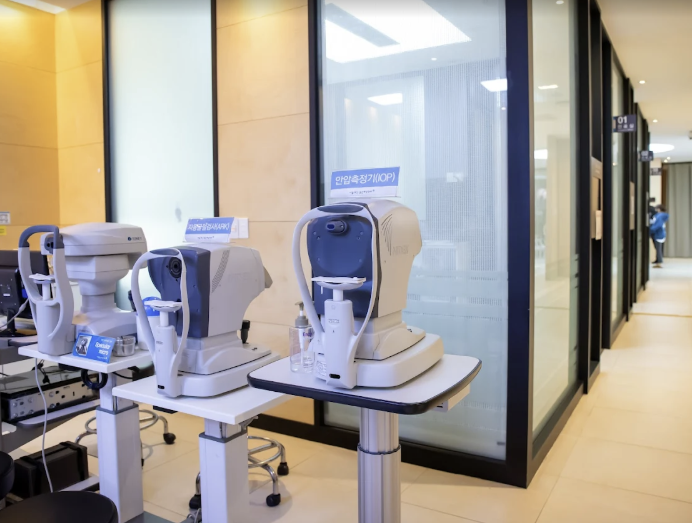
Corneal topography / tomography
Maps the front (and back) surface curvature. Detects irregularities and screens for keratoconus.
Wavefront aberrometry
Measures distortions through the whole eye, including higher-order aberrations.
Pupillometry
Measures pupil size in dim light so the optical zone is large enough to limit night halos.
Pachymetry
Measures corneal thickness to ensure a safe residual stromal bed after treatment.
Which custom profile fits which eye?
Custom LASIK is an umbrella term. Your surgeon picks one of these approaches.
| Profile | What it does | Typically chosen when |
|---|---|---|
| Wavefront-optimised | Preserves natural corneal asphericity to avoid inducing spherical aberration | Few pre-existing aberrations; routine prescriptions |
| Wavefront-guided | Treats measured whole-eye aberrations | Significant higher-order aberrations; reliable wavefront capture |
| Topography-guided | Smooths irregularities on the corneal surface | Irregular but stable cornea; some enhancements |
| Optical zone sizing | Adjusts treatment diameter to pupil size | Large pupils or night-driving concerns |
For wavefront specifics see wavefront LASIK.
Your treatment plan and price within 24 hours
- 1 Send a photo of your glasses or prescription
- 2 Get a likely procedure and estimated cost
- 3 Reserve an exam slot for your trip
No obligation · English · 中文 · 日本語 · Tiếng Việt · Монгол · Bahasa Indonesia
Why personalisation affects night vision and safety
Early, non-custom laser profiles tended to induce spherical aberration , flattening the centre of the cornea more than the edge. In dim light, when the pupil widens, that mismatch can cause halos and reduced contrast.
Personalised profiles aim to limit this, and the same data set also improves safety screening : tomography can reveal early corneal weakness that would make any LASIK unwise. In that case, your surgeon will recommend LASEK, SMILE Pro or ICL instead.
- Larger, pupil-matched optical zones
- Less induced spherical aberration
- Better detection of unsuitable corneas
- Plan reviewed and approved by your surgeon
Is custom LASIK right for you?
General criteria; your exam decides.
Good candidates
- Age 18+ with stable prescription
- Mild–moderate myopia, hyperopia or astigmatism
- Normal corneal thickness and stable topography
- Concern about night vision or contrast
BGSS Eye Clinic 2026 prices
Every package includes the pre-operative exam, the surgery and standard post-op medications.
| Procedure | Price (KRW) | Approx. USD | Recovery |
|---|---|---|---|
| LASIK (both eyes) | ₩1,900,000 – ₩2,400,000 | $1,340 – $1,690 | 1 day |
| LASEK / PRK (both eyes) | ₩2,200,000 – ₩2,800,000 | $1,550 – $1,980 | 3–5 days |
| SMILE / SMILE Pro (both eyes) | ₩2,500,000 – ₩4,000,000 | $1,760 – $2,830 | 1–2 days |
| EVO ICL (both eyes) | ₩5,200,000 – ₩7,000,000 | $3,670 – $4,950 | 1 day |
| Cataract / presbyopia lens (per eye) | ₩1,500,000 – ₩7,250,000 | $1,060 – $5,120 | 1–2 days |
USD values are approximate and vary with exchange rates. Final pricing is confirmed after your pre-operative exam.
- Full pre-operative diagnostic exam (2–3 hours)
- Surgery performed by a board-certified ophthalmologist
- Standard post-op eye drops and check-ups before you fly
- Medical interpreter and English medical records
Which procedure fits your eyes?
Answer 3 quick questions to see the procedure most often suited to people like you, with the 2026 starting price. Then send it to a coordinator for a free personal review.
- FREE No obligation, no deposit to ask
- 24h Reply from our international team
- MD Final plan confirmed by an ophthalmologist after your exam
How old are you?
Written and reviewed by the surgeons who perform it
Every figure on this page is a published BGSS total or a public credential you can check.
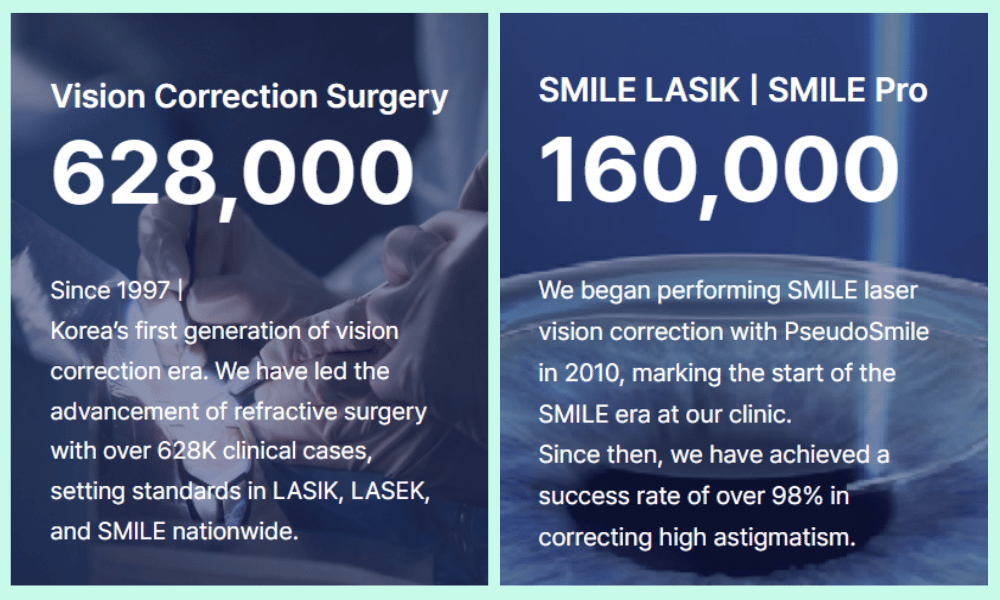
- 160,000+ SMILE / SMILE Pro
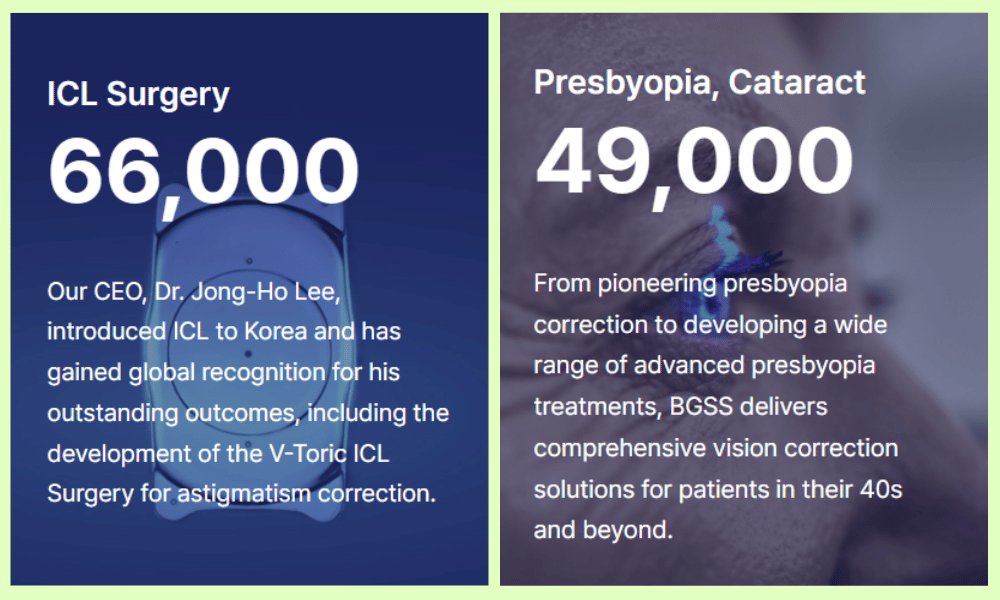
- 66,000+ ICL lens implants
- 49,000+ presbyopia & cataract
- Many with M.D., Ph.D. research backgrounds
- Founder Dr. Jong-Ho Lee: 56,000+ ICL eyes
- Complex-case and toric ICL positioning
- STAAR Surgical EVO ICL APAC Experts Summit (2024)
- Korea SMILE Forum (2025)
- Korea EVO ICL Forum (2025)
- Among Korea's first to introduce LASIK & LASEK
- Ministry of Health & Welfare–designated regenerative medicine institution
- 2026 prices published openly
- Medical content reviewed by an ophthalmologist
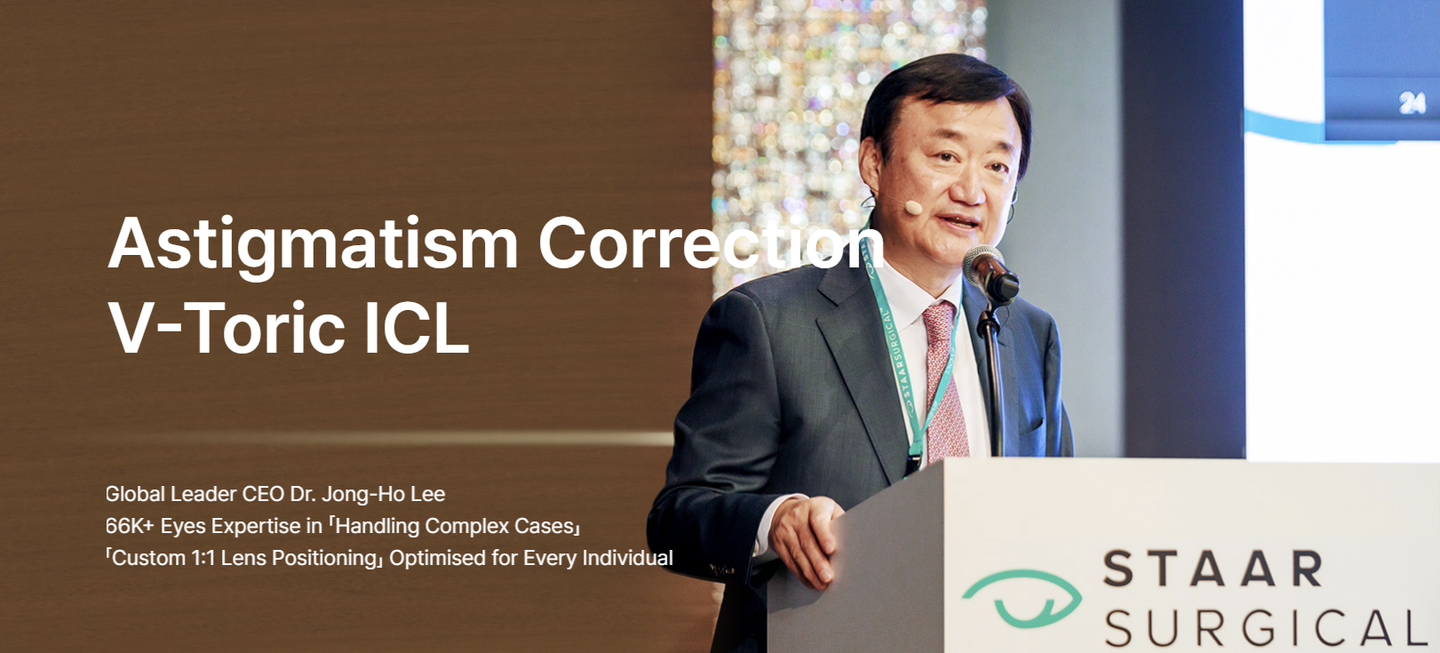
Dr. Jong-Ho Lee, M.D., Ph.D.
Dr. Lee is a pioneer of first-generation LASIK, LASEK and ICL in Korea and is known internationally for complex-case ICL and custom lens positioning for astigmatism. He reviews the medical content on this website.
Editorial policy: clinical statements on this page are checked against the sources below and BGSS outcome data, and are reviewed at least once a year. Prices are the clinic's published 2026 rates.
How surgery in Korea works, step by step
Most international patients plan a stay of about one week. Your coordinator confirms the exact timeline after reviewing your records.
Send your details
WhatsApp, LINE, WeChat or KakaoTalk your prescription and preferred dates. Free, with no obligation.
Get a personal plan
Receive a likely procedure, an estimated cost and a reserved exam slot.
Exam & surgery in Seoul
A 2–3 hour exam with your surgeon. If suitable, surgery can often be the same or next day.
Follow-up & fly home
Post-op checks before departure, then remote follow-up. Your surgeon confirms when it is safe to fly.
Frequently asked questions
Is custom LASIK more expensive?
At BGSS, wavefront and topography customisation are built into LASIK, priced at ₩1,900,000–₩2,400,000 (about $1,340–$1,690) for both eyes, including the exam.
Is custom LASIK the same as wavefront LASIK?
Wavefront-guided LASIK is one type of custom LASIK. Custom can also mean wavefront-optimised or topography-guided treatment.
Does custom LASIK guarantee perfect vision?
No procedure can guarantee that. Customisation aims to improve quality of vision and reduce side effects, but results vary between individuals.
Is custom LASIK bladeless?
At BGSS, yes — flaps are made with a femtosecond laser. See bladeless LASIK.
What is the recovery like?
The same as standard LASIK: most people see functionally the next day, with dry eye and night halos usually settling over weeks.
Ready to see clearly? Start with a free consultation.
Send your prescription today and get a personal treatment plan and price estimate within 24 hours.
- Free consultation
- No obligation
- Reply within 24 hours
- Korea's first JCI-accredited eye clinic
Medical information on this page is for general education and does not replace a consultation with an ophthalmologist. Results vary by individual, and suitability is determined after a full pre-operative eye examination. Statistics: BGSS Seoul + Busan cumulative totals as of December 2025.
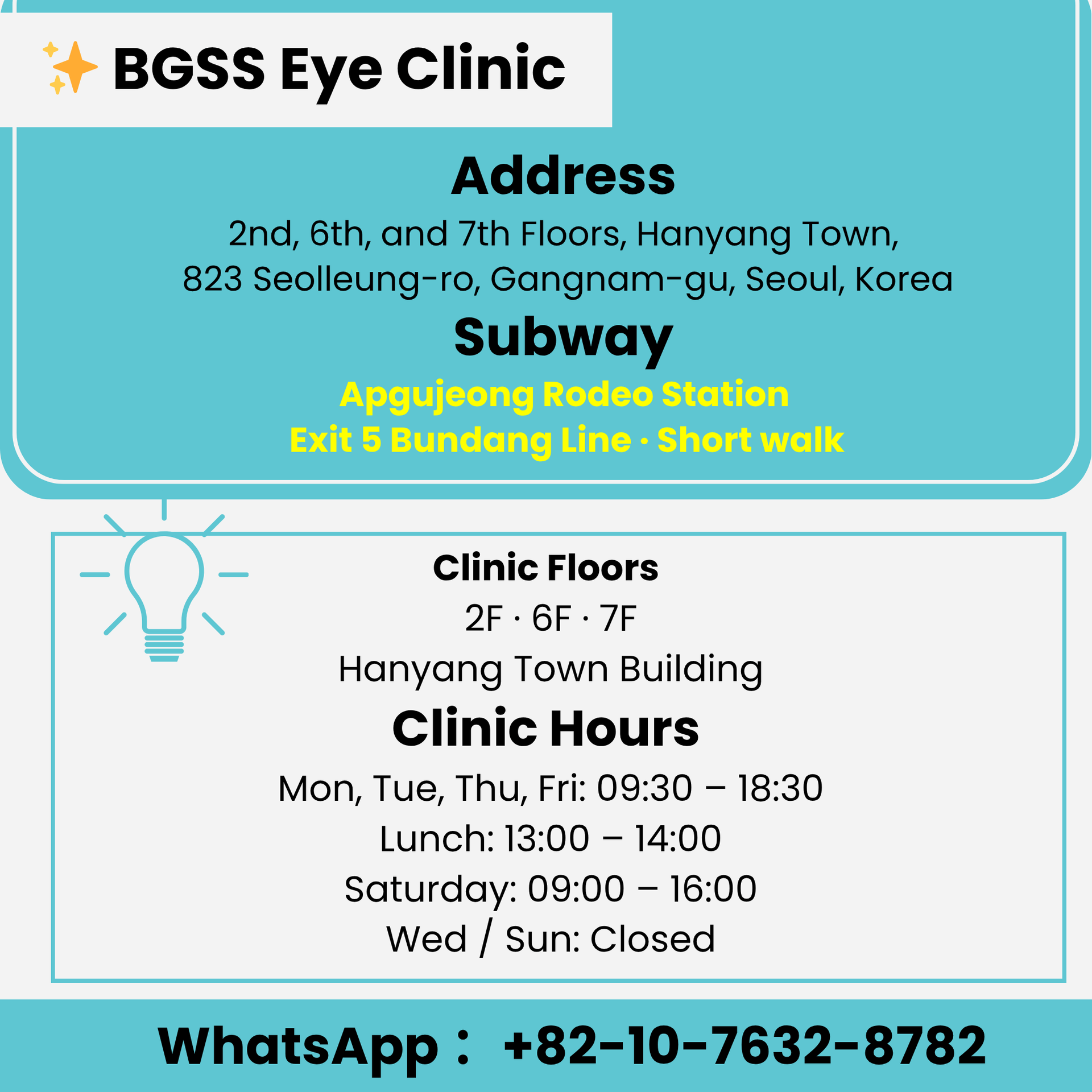
Advanced Personalized Laser Vision Correction in Apgujeong, Gangnam, Seoul
Custom LASIK in Korea refers to wavefront-guided or topography-guided LASIK designed around your eye’s unique optical fingerprint. Instead of applying a standard correction pattern, Custom LASIK uses high-resolution diagnostic mapping to correct both lower-order refractive errors (myopia, hyperopia, astigmatism) and higher-order aberrations that affect night vision and contrast sensitivity.
At Seoul BGSS Eye Clinic in Apgujeong, Custom LASIK protocols are developed after comprehensive corneal and wavefront analysis to maximize visual clarity and long-term stability.
What Is Custom LASIK?
Custom LASIK integrates advanced diagnostic technology to create a personalized laser ablation profile.
Core Technologies Used
✔ Wavefront Aberrometry
✔ Corneal Topography & Tomography
✔ Pachymetry (corneal thickness mapping)
✔ Tear Film & Ocular Surface Evaluation
This data-driven approach helps optimize:
- Night vision performance
- Glare and halo reduction
- Contrast sensitivity
- Precision refractive correction
Why Choose Seoul BGSS Eye Clinic in Apgujeong, Gangnam?
✔ Comprehensive Pre-Surgical Evaluation
Each patient undergoes detailed refractive and structural assessment before surgery is recommended.
✔ Customized Treatment Planning
If Custom LASIK is not ideal, alternative options such as SMILE or lens implantation may be discussed based on corneal thickness, lifestyle, and refractive level.
✔ International Patient Support
- English-speaking coordinators
- Structured pre- and post-operative guidance
- Efficient scheduling for medical travelers
Benefits of Custom LASIK
FeatureBenefitPersonalized Laser ProfileTailored correction based on your eye dataHigher-Order Aberration TreatmentImproved clarity in low-light settingsAdvanced Laser SystemsHigh precision & safetyRapid RecoveryFunctional vision often improves within 24–48 hours
Who Is a Good Candidate?
Custom LASIK may be suitable if:
- Age 18 or older
- Stable prescription for at least one year
- Adequate corneal thickness
- No advanced corneal disease
- Realistic expectations about results
Final eligibility is determined after in-clinic diagnostic testing.
Procedure Overview
- Advanced diagnostic mapping
- Personalized laser programming
- Flap creation (femtosecond laser)
- Excimer laser reshaping
- Postoperative monitoring
The procedure typically takes 10–15 minutes per eye.
Recovery & Aftercare
- Mild dryness or light sensitivity initially
- Antibiotic and lubricating drops prescribed
- Avoid eye rubbing
- Follow-up examinations to monitor healing
Most patients resume daily activities within a few days.