Cataract Surgery FAQ — 12 Questions Patients Ask Most
Straight answers about cataract surgery in Korea: timing, lens choice, cost per eye, recovery, risks and travel. Reviewed by BGSS ophthalmologists, who have performed 49,000+ presbyopia and cataract surgeries.
- ₩1.5M–₩7.25M per eye, exam included
- Functional vision usually within 1–2 days
- Monofocal, EDOF and trifocal lens options
When should I have cataract surgery?
Cataract surgery is usually advised when clouding of the lens starts to interfere with daily life — driving at night, reading, work or hobbies — rather than at a fixed stage. Delaying rarely harms the eye, but very dense cataracts can make surgery more complex. At BGSS, surgery costs ₩1.5M–₩7.25M per eye depending on the lens, with functional vision usually within 1–2 days.
- Price (per eye)
- ₩1.5M – ₩7.25M
- Technique
- Phacoemulsification + IOL
- Recovery
- 1–2 days
- Typical stay
- About 1 week
Cataract surgery at BGSS in brief
Key facts before you read the questions.
| Topic | Answer |
|---|---|
| Price | ₩1,500,000–₩7,250,000 (≈ $1,060–$5,120) per eye, by lens |
| Anaesthesia | Numbing eye drops; you stay awake |
| Time in theatre | Typically about 15–20 minutes per eye |
| Recovery | Functional vision usually within 1–2 days |
| Stay in Korea | About one week; second eye after the first is checked |
See cataract surgery in Korea for the full procedure guide and Clareon PanOptix Pro for premium trifocal lenses.
Your treatment plan and price within 24 hours
- 1 Send a photo of your glasses or prescription
- 2 Get a likely procedure and estimated cost
- 3 Reserve an exam slot for your trip
No obligation · English · 中文 · 日本語 · Tiếng Việt · Монгол · Bahasa Indonesia
BGSS Eye Clinic 2026 prices
Every package includes the pre-operative exam, the surgery and standard post-op medications.
| Procedure | Price (KRW) | Approx. USD | Recovery |
|---|---|---|---|
| LASIK (both eyes) | ₩1,900,000 – ₩2,400,000 | $1,340 – $1,690 | 1 day |
| LASEK / PRK (both eyes) | ₩2,200,000 – ₩2,800,000 | $1,550 – $1,980 | 3–5 days |
| SMILE / SMILE Pro (both eyes) | ₩2,500,000 – ₩4,000,000 | $1,760 – $2,830 | 1–2 days |
| EVO ICL (both eyes) | ₩5,200,000 – ₩7,000,000 | $3,670 – $4,950 | 1 day |
| Cataract / presbyopia lens (per eye) | ₩1,500,000 – ₩7,250,000 | $1,060 – $5,120 | 1–2 days |
USD values are approximate and vary with exchange rates. Final pricing is confirmed after your pre-operative exam.
- Full pre-operative diagnostic exam (2–3 hours)
- Surgery performed by a board-certified ophthalmologist
- Standard post-op eye drops and check-ups before you fly
- Medical interpreter and English medical records
Which procedure fits your eyes?
Answer 3 quick questions to see the procedure most often suited to people like you, with the 2026 starting price. Then send it to a coordinator for a free personal review.
- FREE No obligation, no deposit to ask
- 24h Reply from our international team
- MD Final plan confirmed by an ophthalmologist after your exam
How old are you?
Written and reviewed by the surgeons who perform it
Every figure on this page is a published BGSS total or a public credential you can check.
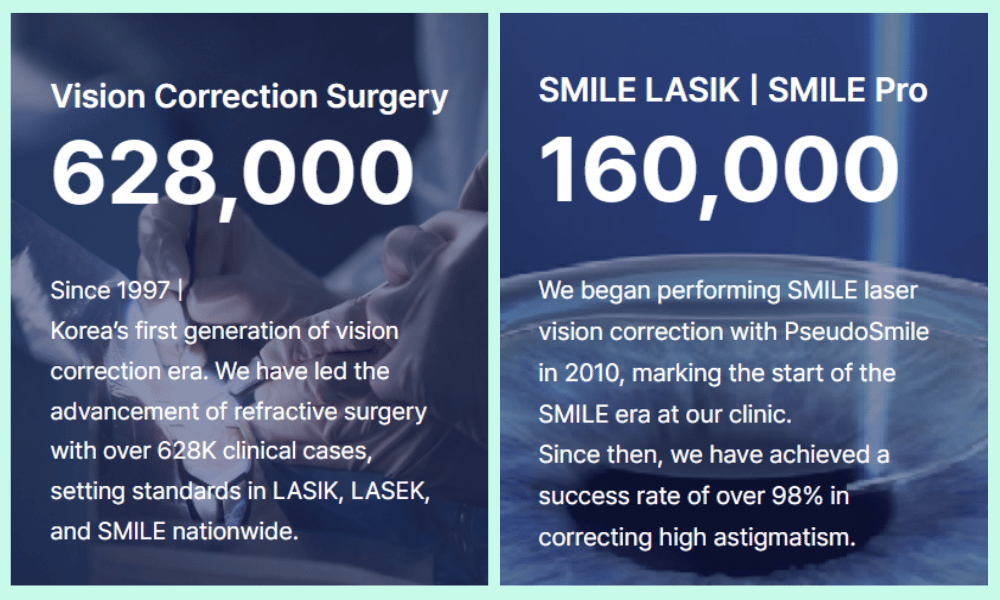
- 160,000+ SMILE / SMILE Pro
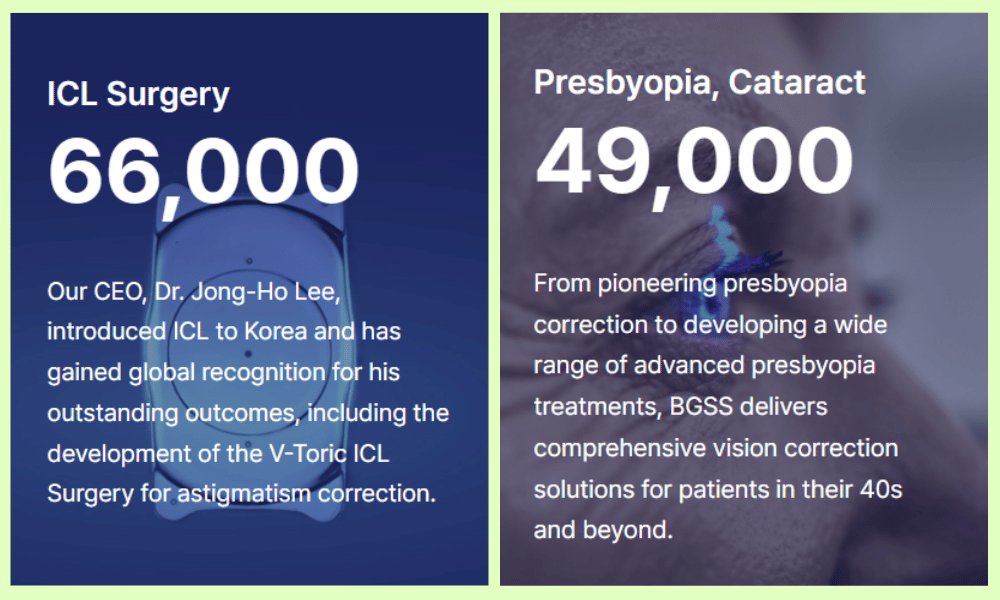
- 66,000+ ICL lens implants
- 49,000+ presbyopia & cataract
- Many with M.D., Ph.D. research backgrounds
- Founder Dr. Jong-Ho Lee: 56,000+ ICL eyes
- Complex-case and toric ICL positioning
- STAAR Surgical EVO ICL APAC Experts Summit (2024)
- Korea SMILE Forum (2025)
- Korea EVO ICL Forum (2025)
- Among Korea's first to introduce LASIK & LASEK
- Ministry of Health & Welfare–designated regenerative medicine institution
- 2026 prices published openly
- Medical content reviewed by an ophthalmologist
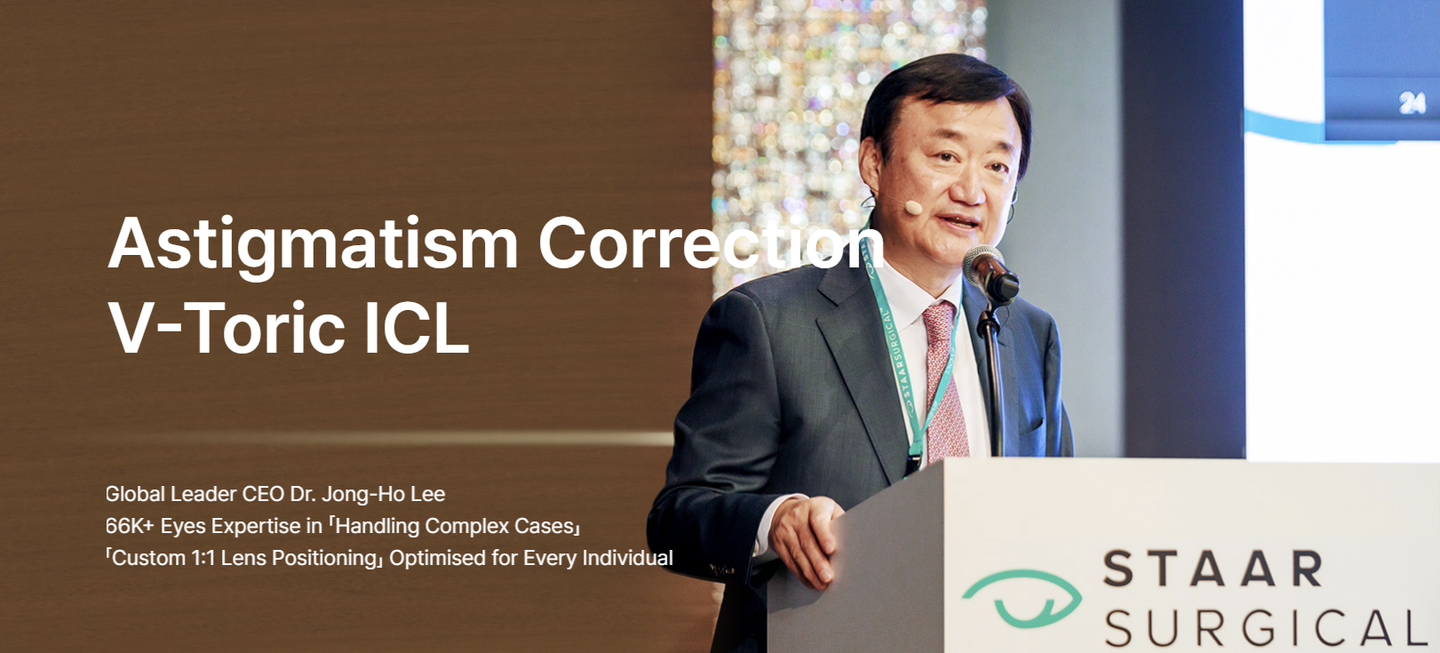
Dr. Jong-Ho Lee, M.D., Ph.D.
Dr. Lee is a pioneer of first-generation LASIK, LASEK and ICL in Korea and is known internationally for complex-case ICL and custom lens positioning for astigmatism. He reviews the medical content on this website.
Editorial policy: clinical statements on this page are checked against the sources below and BGSS outcome data, and are reviewed at least once a year. Prices are the clinic's published 2026 rates.
Cataract surgery: frequently asked questions
What is a cataract?
A cataract is clouding of the eye's natural lens, usually due to ageing. It causes blurred or dim vision, faded colours, glare and halos around lights, and frequent changes in glasses prescription.
Can cataracts be treated with drops or medication?
No. No drop or medicine has been shown to clear a cataract. Surgical lens replacement is the only effective treatment.
How much does cataract surgery cost in Korea?
At BGSS, ₩1,500,000–₩7,250,000 (about $1,060–$5,120) per eye, including the exam, surgery and standard medications. The intraocular lens is the main factor in the price.
Which lens should I choose?
Monofocal lenses give sharp vision at one distance (usually far). EDOF lenses extend into intermediate range. Trifocal lenses such as Clareon PanOptix Pro add near vision but can cause more night halos. Your eye health and lifestyle decide.
Does cataract surgery hurt?
Numbing drops are used, so most people feel pressure rather than pain. Mild grittiness or watering for a day or two afterwards is common.
How long does recovery take?
Most people have functional vision within 1–2 days, with vision settling over several weeks. Drops are used for several weeks.
Can both eyes be done on the same trip?
Often yes. The second eye is usually treated a day or more after the first, once the first has been checked. Plan about one week in Korea.
When can I fly home?
Flying is generally possible within days. Your surgeon examines your eye before departure and confirms when it is safe to fly.
What are the risks?
Possible complications include infection, inflammation, raised eye pressure, retinal swelling and, rarely, retinal detachment. Later, the capsule behind the lens may cloud, which is treated with a quick laser procedure.
Can a cataract come back?
No — the natural lens is removed. However, the capsule holding the new lens can become hazy months or years later (posterior capsule opacification), and a short laser treatment restores clarity.
I had LASIK before. Can I still have cataract surgery?
Yes. Previous refractive surgery makes lens-power calculation more complex, so bring any old records you have. Your surgeon will account for it when choosing the lens.
Will I still need glasses?
It depends on the lens. With a monofocal lens most people need reading glasses; EDOF and trifocal lenses reduce dependence on glasses, but no lens can guarantee complete independence.
Ready to see clearly? Start with a free consultation.
Send your prescription today and get a personal treatment plan and price estimate within 24 hours.
- Free consultation
- No obligation
- Reply within 24 hours
- Korea's first JCI-accredited eye clinic
Medical information on this page is for general education and does not replace a consultation with an ophthalmologist. Results vary by individual, and suitability is determined after a full pre-operative eye examination. Statistics: BGSS Seoul + Busan cumulative totals as of December 2025.